Egypt's lifeline
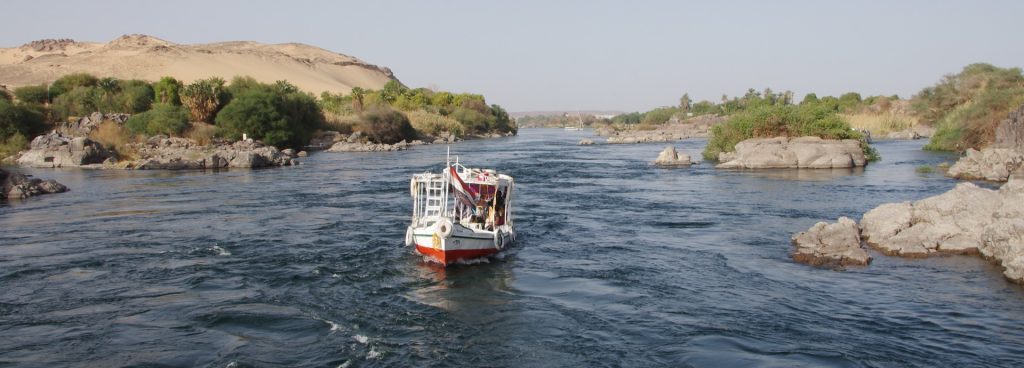
The Nile, the longest river in the world, begins its journey in the rainforests of the heart of Africa, in Burundi, with the source rivers of the Kagera, which flows through Lake Victoria and Lake Albert. In the northern Sudanese wetlands, it is joined by the Gazelle River and the Giraffe River, and together with the Sobat, it continues its journey as the "White Nile" to Khartoum. There, it merges with the "Blue Nile" and shortly thereafter with the Atbara to overcome the remaining 3.000 km across the Sahara. With a total length of 6.671 km, it flows along its course. Annually, it delivers 55,5 billion cubic meters of water to Egypt and 18 billion cubic meters to Sudan.
Nile water is one of the most precious resources in a country where it rarely rains. Since ancient times, the water has been meticulously distributed to the surrounding embankments using a sophisticated system. The monsoon rains cause the Nile to swell once a year, reaching a water level between
The Nile rises by up to 6 meters in July and October. For centuries, the fate of the country depended on the Nile flood.
There was constant anxiety about whether the floods would fail to occur or would be too severe. Even though the floods were regular occurrences, their height varied and thus determined the upcoming harvest. The majority of the agricultural land lies on the western shore.
Since 1971, the Nile's floodwaters have been impounded at the Aswan High Dam, near Aswan, ensuring a year-round water supply for the country. Large desert areas can thus be cultivated and irrigated. Multiple harvests have become possible – vital for a country whose population increases by one million every year. The generated electricity powers approximately 4.000 villages. The 900-kilometer-long Nile Valley is between 4 and 25 kilometers wide and widens north of Cairo into the Nile Delta, which is 250 kilometers wide at the Mediterranean Sea. Its distributaries are among the most fertile regions of the country. In the delta alone, which the Nile once carved out with five branches (now two remain), the fertile land reaches a considerable area of 25.000 square kilometers.