Interesting facts about the gigantic tropical winds
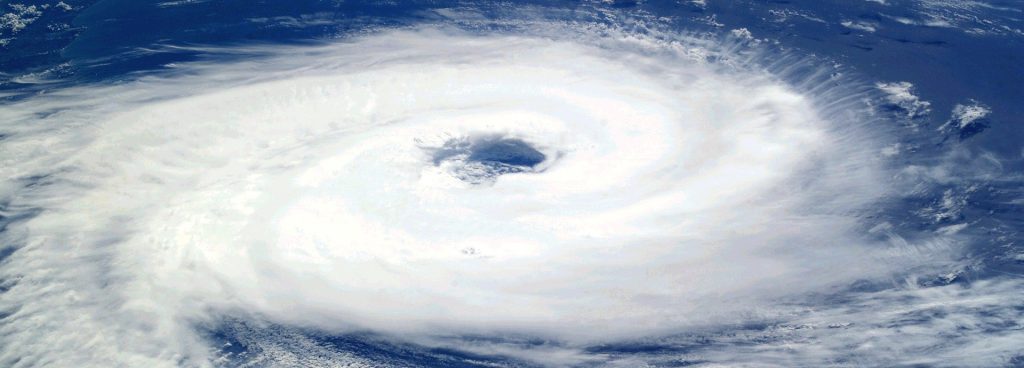
Hurricanes are tropical cyclones of gigantic proportions in North and Central America and the Caribbean.
Including its outer regions, a hurricane can reach a diameter of up to 1.500 km and moves at a speed of 8 to 32 km/h.
Depending on its geographical origin, it's called a typhoon, cyclone, or willy-willy. However different the names may be, the formation and appearance of these exceptional storms are the same worldwide:
Intense solar radiation heats the tropical oceans so much that even at a depth of 60 meters, the water temperature is at least 27°C. Over large and sufficiently deep ocean areas, immense quantities of water evaporate and are absorbed by the air. These warm, moist air masses rise to altitudes of up to 20 km. The condensation of the water vapor releases considerable heat, and thus energy – this process is considered the primary energy source and driving force behind vortex formation.
Once this circulation begins, it fuels the hurricane and is almost impossible to stop. For this circulation to occur at all, there must be a uniform flow in the lower atmosphere, and air masses from different directions must collide at higher altitudes.
Additionally, the Coriolis force, the deflecting force of the Earth's rotation, influences the formation of hurricanes. It is only through the Earth's rotation that hurricanes acquire their characteristic vortex shape.
Warm, moist air masses stream in from all directions, rise, cool, and then flow out laterally. Over time, a circular low-pressure zone forms in the center – the so-called eye of the hurricane. It can reach a diameter of 30 to 60 km. The cold air aloft descends, the clouds dry from the top down, and thus this area remains dry.
From there, you can even see the blue sky or the stars while the hurricane rages around the eye. Once the hurricane makes landfall, its energy supply stops because it no longer absorbs moisture. Nevertheless, it can rage across the country for several days or even weeks, causing devastating damage in coastal areas. Due to the enormous power of a hurricane, a special scale—the Saffir-Simpson Hurricane Scale—had to be created, as the Beaufort scale commonly used to measure wind speed was insufficient to express its intensity. The Saffir-Simpson Hurricane Scale begins at a wind speed of 118 km/h, where the Beaufort scale ends.
Important information in case of a hurricane:
Hurricanes are classified into five categories according to their intensity, with Category 5 being the most severe storm. Unfortunately, despite the most modern meteorological tools, neither the formation nor the path of a hurricane can be predicted. In the Caribbean, a simple storm can quickly and unexpectedly transform into a dangerous hurricane. Should a weather system develop, which mainly occurs between August and October, the Dominican authorities immediately take initial precautionary measures. To prevent rumors and panic among the population, officials inform the islanders about the development of the disturbances.
If the storm is 36 hours away from the coast, the 1. Warning (primera alerta)Although it's impossible to predict at this point whether the storm will even reach the coast, this warning is issued more as a precaution. You should refrain from swimming in the sea from now on.
The 2nd warning (segunda alerta) This will take place once the storm is twelve hours away from the coast. At the discretion of the authorities, you and the other hotel guests will be accommodated in storm-proof shelters (refugios), where you should only take your personal valuables and a small bag.
The 3rd warning The warning is issued when the hurricane is still three hours away. At this point, any evacuation measures must be completed, and no one may leave their accommodation until the authorities have officially declared the danger over. Once the danger has passed, you will receive further information from your hotel representatives or tour operator. Please be patient if the flow of information is somewhat slow at this time, as power outages and telephone service disruptions are not uncommon after a hurricane. We appreciate your understanding in such cases.
We wish you a storm- and hurricane-free stay on Hispaniola.